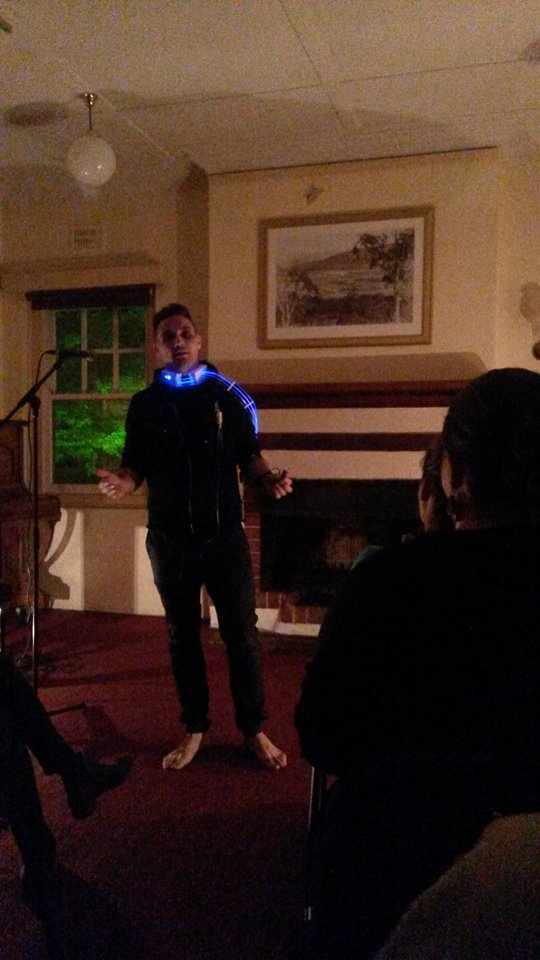
Okay, the preview showing of Bomb Collar was last night (I ran it through in front of 30 good friends as a way to get past my nerves and see where it’s at). It debuts 9.30 this Saturday night as part of Crack Theatre festival. So I guess it’s time to reveal what the hell it is!
Bomb Collar is, for want of a better term, a one-man science fiction cabaret show. It stars yours truly as The Last Singer On The Face Of The Earth, in a dystopian future where mankind is genetically recessive and traits like musical ability have eroded away. He is giving a concert for the revolutionary army who keeps and protects him, but he still bears the legacy of a violent tragic past in the form of an explosive that’s stuck around his neck. He could, in fact, explode at any time..
I’ll get in-deep about the whole show and my process on the other side of Crack, but suffice to say that a one man show is above and beyond any challenge I’ve previously set for myself. It’s been super-daunting, and last night’s performance showed up a bunch of stuff that still needs work (thanks to my savvy and generous preview audience!) but it was also a lot of fun to do and I’m raring to see how it goes over with an experimental theatre crowd.
If this comes off it’ll be down to the amazing efforts of director/dramaturg Emma MacManus, music producer/arranger Sam King, and the incredible team of Paul Heslin and Adam Thomas who have built the very unique sound and light rig for the show.
Above photo by my friend Ali Goward. Come see me this weekend if you can, otherwise I’ll see you back here!
I said to Lou the other day that I wanted to make a clip like Lily Allen’s Sheezus or Danny Brown’s ODB.
Though it’s completely obvious now, I didn’t realise they were by the same director – Ruffmercy. Since then, I’ve been devouring all his other videos.
Ruffmercy – real name Russ Murphy – is a Bristol-based animator and director. He’s worked for companies like MTV since the 90s, but it was his video for Dahlia Black’s Fuck A Rap Song that made his name as a director. Inspired by a gif he was sent for reference, he started drawing over the frames of the video, inventing an aesthetic that synthesises graffiti, Ralph Steadman, Basquiat, and every schoolkid that’s added a moustache and a black eye to the cover of a magazine. I love how his motto – ruff, rugged and raw – applies equally to hip-hop and punk. Being a relentless doodler and former stencil artist, it’s a style that immediately appeals.
Messing up film has been an ongoing pursuit for me – I’ve written before (a year ago to the day in fact!), about a Central West gig where multiple projectors where running 8mm reels. Some of this footage was blank frames that had been painted on – it looked amazing. Nearly everything is easier to do digitally these days, but replicating that is not one of them – I ended up buying an off-the-shelf set of ink and paint splattered footage to overlay over my videos, but it’s not the same.
However, what Ruffmercy’s work first reminded me of was the unexpected ending to one of my fave movies, Irma Vep.
I was very taken with the effect, how punk and tactile it felt.
It’s surprising how adaptable Ruffmercy’s technique is – here’s another video utilising the same approach but with a different vibe.
The harsh and jagged lines, the scratched out eyes and teeth, have been replaced with ballooning squiggles and dots. This completely changes the effect, from violent paranoia to something bubbly and pop. The song contributes, but there is no doubt how much personality we imbue into the lines and marks themselves.
In the few interviews online with Ruffmercy, I pieced together enough of his workflow to try myself. Armed with a borrowed drawing tablet, I had a crack over the weekend. I tried a mixture of the poppy and grungy stuff over a few seconds of Kev dancing. It’s clumsier than Ruffmercy’s work, but I was encouraged enough by this first attempt.
As any animator will tell you, it’s time-consuming work. There’s over 500 individual frames making up this brief proof of concept. That said, it’s the kind of work that can be pleasantly done with the radio or TV in the background. I still haven’t figured out how Ruffmercy times his stuff so well to the music, and that will be the focus of my next test.
Music videos are a natural fit, but I’ve also been considering its use in other genres – as transitions between scenes in a sitcom, or in a stylised action sequence. It’s given me a taste for the possibilities in animation – I also stumbled upon this video yesterday AND OH GOD I’M ALREADY BUSY ENOUGH…
This is a piece of my costume from Bomb Collar, my one-man show which debuts in two weeks at Crack Theatre Festival in Newcastle. This piece was made and photographed by Adam Thomas, who as I write this is a couple of blocks away at our friend Paul Heslin’s house integrating the stuff he’s made with other materials that Paul has purpose-built for the show. I’ll be going round there in a moment to pretend I can follow the technological aspect of anything that they’re doing.
I promise answers will be forthcoming soon, but in the meantime I welcome your guesses and conjecture!
Nick: So I went to Luke’s place for dinner last night and pretty much as soon as I got in the door he surprised me with this, the final of five videos for my EPINADAY. I’d pitched the basic approach for this one (and written the ‘dialogue’ and ‘where-are-they-nows’) but Luke took it above and beyond. It’s easily my favourite of the five.
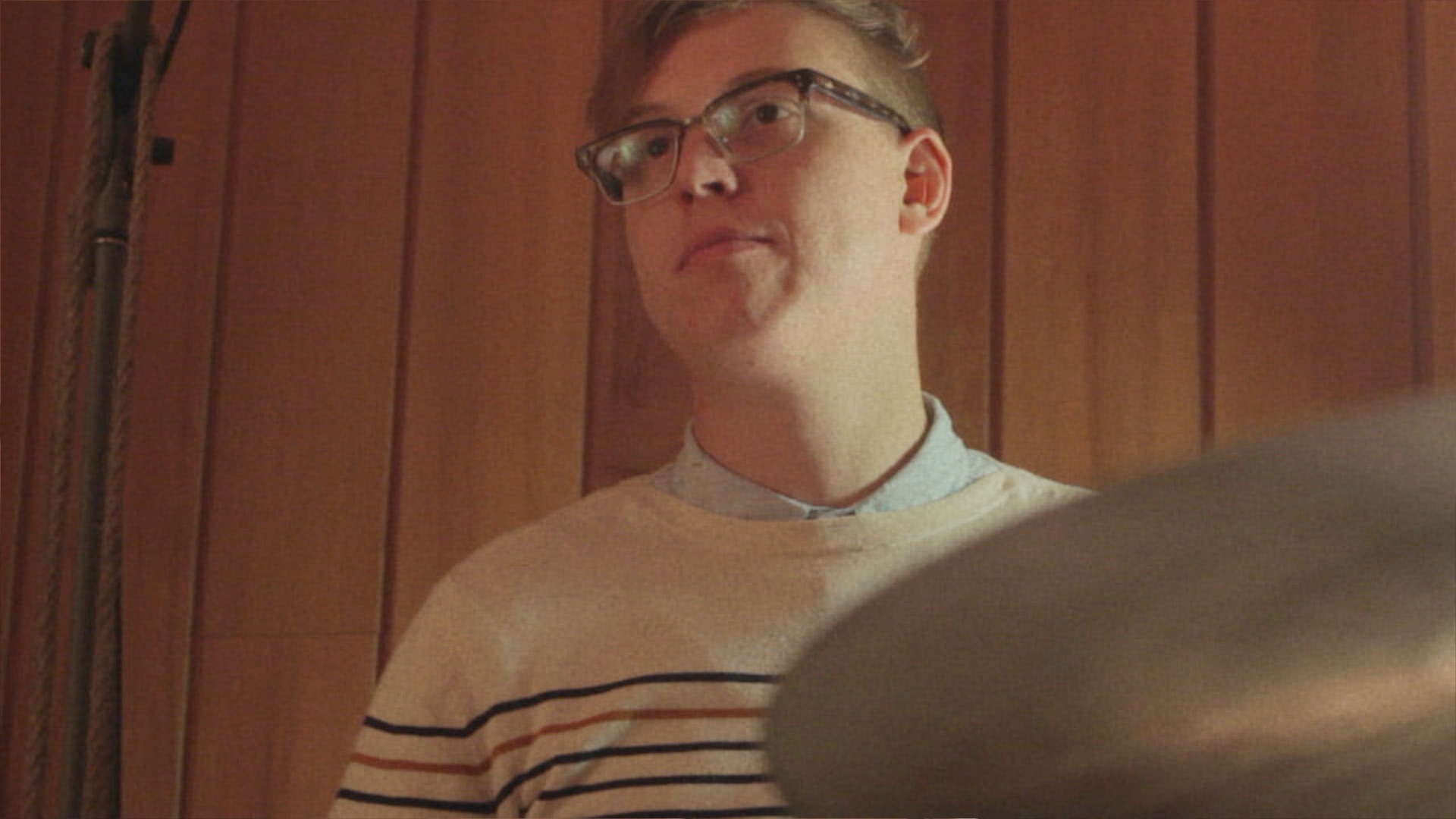
This was another song that I used to play with Big Score, and the arrangement owes a lot to Big Score’s Beth Monzo in particular and Nick Peddle. They were the ones who first turned it from an indie chord-chugger to the afrobeat-ish shuffle it is now, so having Nick drum on this take felt like a nice tribute to all those sweaty pub gigs we’d shared.
I don’t know if this is one of my better songs or not but it’s definitely one of my favourites. I wrote it in my early 20s, I used to write a lot of songs from the perspective of an old man back then. Probably a perverse desire to avoid the normal young-person concerns, or maybe just an attempt to ape all the Old Fogeys Of Song that I love so much.
I had a strong hunch that I’d be personally very satisfied by this project, but I’ve been humbled by the positive response I’ve gotten from those that have watched the vids. Thanks again to the Rogues Gallery who helped me achieve this: Sam King, Julia Johnson, Matt Lustri, Nick Peddle, Shane Parsons, Adam Thomas, Leon Twardy, Adelaide Rief and Luke ‘Beyond Rebuke’ McGrath!
Luke: Huzzah, the final EPINADAY video!
To begin with, I cut together a performance of the song as per the previous videos. With that as a base, I layered the collateral footage over the top – with the exception of a couple of brief moments, it completely subsumed the actual performance.
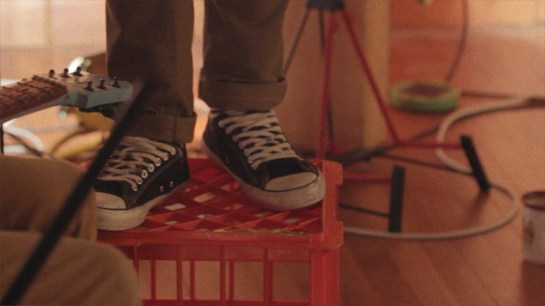
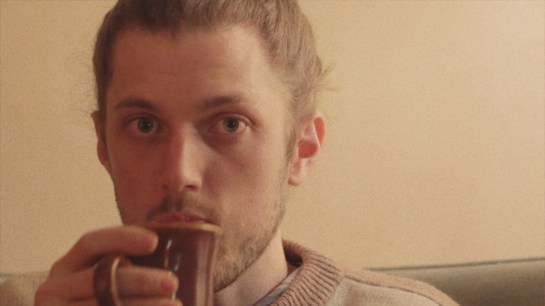
We wanted to impart this last video with a ‘behind the scenes’ vibe. I consciously left in the bits I would normally edit around – camera wobbles, refocussing and the like – as well as the less guarded moments from the musicians. Combined with the warm film look, it feels like a home movie, perfectly suiting the wistful tone of the song.
Overall, the five videos totalled around 20+ hours of editing. As with nearly everything I do, it became a larger task than I anticipated (my skills at gauging time and effort are severely underdeveloped – the silver lining being I jump blindly into a lot of ultimately rewarding endeavours). Having space between each editing session was a bonus – it allowed me to consider each edit independently, to experiment and choose something that suited the individual songs.
Very chuffed to link to this post- http://messandnoise.com/news/4671517- from Mess and Noise about Hollywood, the second single form the forthcoming Cracked Actor record.
Cracked Actor is the only band I’m in that I don’t write or Frontman (I play bass) for so I kind of feel like as much a fan of the band as a member.CA’s illustrious singer/writer Seb has always been a widescreen-vision type of guy but he’s outdone himself on this new album. I’ve never worked with anyone who’s been able to contain such a complex and specific (and excellent) vision across all the metrics of recording (song, arrangement, performance, production) and keep it so close to what he wants. He and our drummer/sonic know-it-all Graham have been sweating the details of this one for almost a couple of years now (ably abetted by Producer-To-The-ACT-Stars Sam King) and unlike a lot of records that take this long I feel like you’ll hear every moment of care on the finished article. These guys are also the most ruthless song editors I’ve ever worked with, which has had a big influence on my own writing.
The link has all the info about our little single tour that;s happening over the next six weeks. If we’re playing close-by to you please drop in and say hello!
Nick: The other three EPinaday songs have all had previous lives in bands that I’ve played them with. This track, whilst it’s been kicking around for a couple years, had never been performed live or even rehearsed by a band before. For that reason it feels like the most honest expression of the arrange-and-record-in-a-day concept.
In writing terms it’s pretty straight-up Nashville country in the Cash and Carter tradition. Boxing matches are a metaphor I seem to keep coming back to, probably because of all the great terminology that exists in the sport (plenty of my trademark apocalyptic imagery sneaks in too). Musically there’s a certain gleeful dumbness to the chunka-chunk chorus that we all leaned into. There’s a 7th chord in there among the usual major chords, which makes it practically jazz by my standards.
Luke: After the multi-cam extravaganza of World Of Hurt, and the demure black and white of Lake George, I was at a loss for how to approach Seeing Stars. Quick edits? Lots of inserts? More of the same?
Nick provided me with the key – he said (and I’m paraphrasing), “It’s a country song, innit? So go punk with it. Blank Generation. Them bleedin’ squares won’t know what hit ’em”. Blank Generation is a touchstone between us – 16mm unsynched black and white reels of bands playing CBGBs in the late 70s. It’s essentially home movies, some of bands that became the biggest in world – Blondie, Talking Heads, Patti Smith, Ramones, and others that became cult favourites – Television, Wayne County, Tuff Darts, to name a few. Put simply, it’s the coolest footage ever filmed.
I didn’t go Blank Generation on Seeing Stars. But the suggestion freed me to not be so precious with the footage. I wanted to do something similar to this video of PROM, to recast it as a long-lost VHS nasty. With that as a starting point, I put together the ‘interrupted transmission’ intro, to indicate a clean break from the slicker videos that came before (the dubbed Spanish sitcom dialogue was a perverse piece of whimsy).
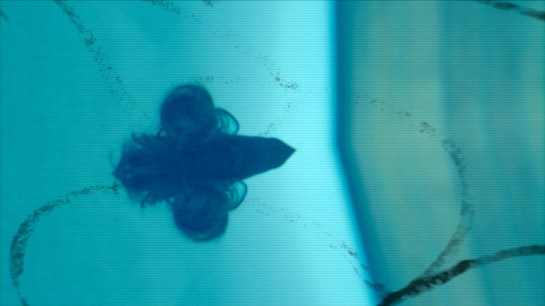
There is a veneer of TV static over the footage (though not as extreme as Nothing But Flowers), and then from there, things get… weird. The doubled footage, the squiggly black lines, and the day-glo colours were the result of a fun morning of experimentation (which also yielded hideous Rubber Johnnies like this):
To me, it’s come out quite psychedelic, and I like the idea of both Nick and Julia seemingly singing this duet not to each other, but to mirrored versions of themselves.
My favourite moment though is when Sam King’s head disappears – it’s like there’s an invisible lake in the middle of the frame – his topknot bobs above a moment before sinking completely. Beautiful.
We’re about 5 weeks out from Bomb Collar, the show that I’m writing and performing for Crack Theatre Festival. I’m not quite ready to spill the beans on this one, but suffice to say that I’ve had to generate a fair bit of story world material which won’t end up featuring in the story itself. The following is a historical timeline that I wrote leading up to the first moment of our show.
Bomb Collar Backstory Timeline
Curtain minus 105 Years– The song ‘Battle In Heaven’ by Adara Spread becomes the highest selling unit of entertainment in history. The song is heavily criticized for it’s glorification of armed conflict but is almost universally embraced by the dominant 8-20yr-old age bracket. Illegal re-interpretations of the song generate a cottage industry that effectively becomes the world’s 6th largest economy. 73% of all music heard in this, the last meaningful year of capitalism, is ‘Battle In Heaven’.
Curtain Minus 100 Years- Public panic over info-virus’s and artistic pollution lead to a resurgence in nationalism. Entire populations retreat into firewalled ‘thought reserves’ separate from the public internet. Cult political figures find themselves holding influence over tens of millions of people, most notably Fillip Despin and his ‘Golden List’ of acceptable and safe culture.
Curtain Minus 95 Years- The aggressive decentralization of knowledge has led to massive global interdependency, with many manufacturing practices only known in specific geographical locations. Mass shortages of sanitation gels and temperature control shakes lead to civil unrest among the Deep Ocean Colonies. Christian refugees from the Continents bring rumors of genocide. The thought reserves, once giant echo chambers of re-enforced opinion, splinter off into their own dissenting groups.
Curtain Minus 90 Years- 1.2 billion people are wiped out in the Golden March, executed for their cultural, artistic and religious beliefs. A vast Oceanic Alliance rises up in response, as if to fight one last great war, but it is too late. The global manufacturing chain fatally damaged, both sides of the conflict collapse under their own weight. The war over, local political and military leaders are forced to broker their own peace treaties, usually too late to avoid mass devastation.
Curtain Minus 80 Years- In the wake of the Failed War, an international movement of pilgrim technicians (‘Panners’) travel the earth, trying to piece together as much lost technical and practical knowledge as they can.Much of said knowledge is lost, but over a decade of effort the Panners are able to retain and restore basic living conditions in most of the Deep Ocean Colonies and the majority of the Continents. Most fast methods of Global Travel have become the preserve of the wealthy or powerful, making their job all the more painstaking.
Curtain Minus 60 Years- With most of the Firewalls negotiated away, the warped and skewed knowledge bases of the Thought Reserves become the basis for mainstream culture. The tenets of each Reserve sit in violent dissonance to the others, leading to bitter cultural conflicts and mass segregation along ideological lines. These warring ideologies eventually infect the Panner population as well, leading to the gradual erosion of this global movement.
Curtain Minus 45 Years- Worldwide communication and trade shrinks to a relative minimum due to ever-increasing ideological schisms. Art and culture from other societies is treated with hostility and skepticism, and each community retains a tightly confined suite of images, songs and stories that are agreed upon and sanctioned. Dissident artistic depictions become extremely rare, having been violently oppressed for years.
Curtain Minus 30 Years- The Deep Ocean Colonies slip into feudalism, dominated by a popular culture which glorifies warfare and expansionism. The extremely degraded state of all travel technologies creates a significant drag factor on these military campaigns, as does the armies’ low level of martial competence. Many of the the smaller settlements are allowed to live in peace for years before being attacked, many of them taking steps to prepare, some choosing to evacuate.
Also,Our Protagonist is born into one of the absolute smallest of the Deep Sea Colonies, a place know as Gales Edge.
Curtain Minus 5 Years- Scilly is taken by expansionist forces. Due to incompetence and mis-communication at the leadership level the people of Gales Edge are wiped out instead of subjugated. Our Protagonist is, as far as he knows, the only survivor.
NICK- Hey Guys, we thought we’d tag-team the post for this, the third of five videos from the EPINADAY.
I originally wrote Lake George to pitch to Luke’s country band The Bluffhearts. The chorus line- ‘it sure ain’t a good idea’ – just popped into my head with the melody attached, and it was one of those good lines that brings the whole narrative with it. I remember sitting down to write it in the leafy backyard of a sharehouse in Hackett, it took about 40 minutes. I went straight out and played it at a gig that night.
It was a bit too 3/4 for the Bluffhearts but it went on to be a bit of a showstopper for Big Score, the jam band I had going with a bunch of other singer-songwriter friends. We use to play a very rocky version with me strumming dumbly on the bass and drummer Nick Peddle going apeshit out of the bridge stop. Nick also plays on this version and it’s a testament to his versatility that he nails the sparse vibe every bit as well.
Obviously it’s the sort of Place Name song were the Place has very little to do with the narrative. That was very much on purpose, as I’d wanted to use an iconic ACT location without trying to say anything about Canberra. It’s a Song-As-Short-Story about dodgy guy meeting dodgy girl, when I wrote it it was pure fiction but in the intervening years I’ve probably skirted close to some of this behavior (though I still don’t drink OR drive).
I’d say it probably still stands up as one of the five best songs I’ve ever written and I love this version. Jules nailed the sing-along hook (which was originally sung by Big Score’s Beth Monzo) but for me it was particularly cool to have her on electric guitar instead of her usual acoustic. Matt resisted my advice to play a busier part, and as always he was right. Sam’s slide licks were played on a homemade guitar that his Dad made as a young man, hopefully we can find a still shot of it to post ’cause that thing is nuts.
LUKE – Lake George is one of my favourite Delatovic songs (I still remember the first time I heard it years ago at a Bluffhearts practice in Mel’s garage). That beautiful, weary line towards the end – “I’ll take off my spurs/And I’ll put on the bridle” – is as perfect and unique a metaphor as it gets. I remember the version Delatovic and Peddle used to play in Big Score as obstreperous, the individual segments coming together like parts from different songs. This take is more cohesive, slower, stately – Sunday morning rather than Saturday night. I needed the edit to reflect this.
Black and white images always seem at a remove. Some people think this remove is one of time, harkening back to the pre-colour era of film. I think the remove is not in time, but in reality – the world we live in is in colour – black and white is hence otherworldly (or just other). It’s a space that belongs to imagination, to movies, and to dreams. It’s set aside from real life, and larger than life in some cases. It can make the ordinary seem artful, and make the artful seem sublime.
All of which is unimportant to the casual observer, but as a filmmaker, it’s certainly an interesting place to start. The dissolves (don’t get me started on dissolves!) enhance the floating atmosphere, and complement the unhurried, hazy pace of the arrangement.
Taking footage from the same session and making four visually distinct videos is a challenge. World Of Hurt and Lake George have set the bar high – I watched Gimme Shelter this week for inspiration – maybe I need to superimpose a long flowing pink scarf onto Nick!
I pitched the idea of ten one-minute songs to EMA label head Oscar Condon at the Wig & Pen the second time I met him. At that point, all that existed was Sno-Globe, written the week before. Sno-Globe, like its namesake, felt to me like it contained a full song/world in miniature. It prompted me to consider a whole album in microcosm, and X (at least as a concept) was born. Oscar loved the idea from the get-go (he was also the sadistic bastard that suggested I make videos for all ten as well).
The beauty of starting with a clear concept was I could just figure out what songs I would need for a rounded album, and then write them fit for purpose. I knew I’d want some kind of mid-point palate cleanser (That’s A Bingo), a song in French (Ou Est Henri?), a song with a starring turn from Mel and Cath (Unusual Curse), and a lot of crunchy rock (everything else). This was also the first tracks conceived knowing Mel and Cath were in the band, so songs like 6BB, Ou Est Henri?, Unusual Curse, and Love, Or Leave It Alone (For Iris), were written with female vocals in mind.
Three songs in particular wear their influences on their sleeves – Good Night was my homage to Cosmic Psychos, That’s A Bingo to Jon Wayne, and Kingdom Of Fear to The Blade Winner.
Cosmic Psychos are new favourites of mine, having only heard their music after watching the brilliant Blokes You Can Trust last year. Good Night is me unabashedly channelling my inner Ross Knight – the only twist I added was to cast the song in the second person, an under-utilised variant in rock’n’roll, and also a first for me.
In contrast, Jon Wayne, the sui generis drunken cow-punk band, have been on my radar for years. I first read about them in Dave Graney’s book It Was Written, Baby back in the 90s, where he extolled their praises and let loose the secret that The Cruel Sea’s Better Get A Lawyercribbed its best lines from their song Texas Jail Cell. They were very popular with me and Na in The Bluffhearts-era, and we adopted some of their catchcries and licks into our repertoire. They are also concept album savants – nearly every song on their masterpiece Texas Funeral has ‘Texas’ in the title. Written in 2010, That’s A Bingo is the only song not written/finished specifically for this album. It sees me adopting the sneering, lecherous vocal style of Jon Wayne’s singer (also pseudonymously called Jon Wayne). I perform it with a guitar pick clutched in my teeth, to replicate the tight-jawed sound of someone talking with a cigarette between their lips.
Kingdom Of Fear was literally me wanting to do my version of a The Blade Winner song – a classic rock tune filled with grand, apocalyptic imagery, similar to his Sweet Babylon.
The blindingly obvious revelation came later – hey, I know The Blade Winner! Why don’t I ask him to sing it? As you can hear, he did not disappoint (though he nearly gets overshadowed by Mel and Cath’s showstopping backing vocals).
The final song conceived for the project was Kevin Lauro’s Blues (Angry Women, Pt. 1). Kev offered to write a song months before we began recording. I quickly agreed, mainly because it saved me writing another one. However, as the recording date drew closer, I began to question this decision. Kev, on a weekly basis, would insist his song was near completion and would be ready to show us all the following week. I was even invited round to his place a couple of times to ostensibly hear it – every time, the sly fox would nonchalantly defer its unveiling to a later date. It became a running joke, some kind of elaborate ruse. With just two weeks to go, and Kev still insisting it would be finished, I figured we needed a Plan B.
I am a huge fan of Lars Von Trier’s The Five Obstructions, the film where he challenges Jorgen Leth to remake The Perfect Human five times, each time with a new set of challenging rules and criteria (The Perfect Human was the inspiration for our current series of projections). On a couple of occasions, Leth does not strictly adhere to the set rules/obstructions – Von Trier then takes it upon himself to ‘punish’ Leth with more severe rules the following time. For the final iteration, Leth’s punishment is that Von Trier will make a version of the film… but it has to be credited to Leth. I co-opted this idea as punishment for Kev – his song, which is one minute of ludic avant-jazz nonsense made up on the spot by the band, had to be credited as written by him, and it had to be called Kevin Lauro’s Blues (in homage to the similar Stooges track L.A. Meltdown Blues). Kev accepted, likely relieved that he no longer had to finish his song (though he was still working on it on the day of recording!). The ‘Angry Women’ suffix comes from Mel and Catherine’s contribution, the song’s sole lyric, intoned in both French and English.
The last thing recorded for X was Nicholas Coombe’s saxophone. I’ll take a sax solo over a guitar solo any day (as any Missing Lincolns song will attest). To me, sax mixed with electric guitar either sounds like The Stooges or The Saints, two bands I credit as influences (fun fact: the chunky chordal riff of The Missing Lincolns’ Light A Fire Under You came about trying and failing to play Know Your Product). Nick C is a delight, one of the most relaxed and up-for-anything musicians I’ve had the pleasure to play with – he’s now played on Holiday Inn and X, AND performed with us at the launch – I’m surreptitiously trying to make him a fully-fledged member of the band before he notices.
The indelible cover image is by Uy Nguyen. Uy and I met on the first day of year seven – he’s now a talented artist and architect, and when he posted his drawing of a sloth in a bowtie, I was immediately smitten. The mixture of cuteness/evilness, savagery and sophistication, seemed to parallel our sound. The irony of a sloth as mascot for the quickest album in the world was also too good to pass up. I hope to convince Uy to design the covers for our future releases too – it would be brilliant to have an artist of his calibre establish a consistent look for the band’s material.
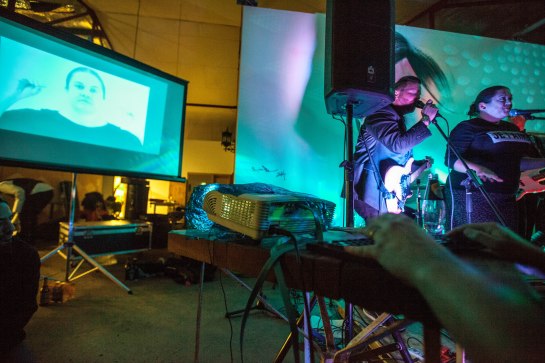
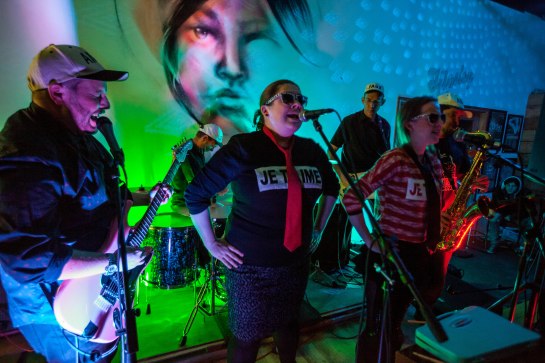
The launch last Saturday was a rollicking good time – as a label, EMA is distinguished by its lack of homogeneity – the night included sets of skeletal folk-pop, grunge, trip-hop, punk, choral electronica and drone. Around 150 people attended, and we sold a bunch of albums. Not wanting to dilute the impact of our one minute blasts, but recognising that the set would be too short otherwise, we played all the songs twice. It was Darren that came up with the idea to do it as a palindrome, playing the songs through the second time in reverse order. It added another layer of playfulness to a gig which also included a (minor) costume change, an intermission gag (thanks Nick!), and a pre-arranged stage crash by The Blade Winner.
For our projections this time, Paul Heslin live vee-jayed. We used the same black and white footage of the band (I hastily filmed new drummer Darren the week before and subbed it in), and Paul coloured our first set red, the intermission white, and the second set blue, to mirror the French flag. Paul is the unsung hero of the FFA family, having implemented our live visuals, remixed Holiday Inn, and recorded overdubs for X. He’s one of my favourite and most trusted collaborators and (friends), and I hope we do lots more together in the future.
With Nathan up on stage, our numbers swelled to seven, and we barely fit on the tiny stage. Combine that with the suit jackets and sunglasses, and I feel like we are entering our Dexys Midnight Runners/Young Soul Rebels phase. Which, excitedly, gives me a whole raft of ideas for the next thing.
 Okay, the preview showing of Bomb Collar was last night (I ran it through in front of 30 good friends as a way to get past my nerves and see where it’s at). It debuts 9.30 this Saturday night as part of Crack Theatre festival. So I guess it’s time to reveal what the hell it is!













 Lick Nuke