As Luke has already said in his previous Heartbroken Assassin post, this is the most ambitious project we've ever done. A ten-part Webisode series shot over ten days, one episode uploaded every day. Every episode including an original song, a scene of violence, and a cameo from at least one You Are Here festival artist and producer. Riskiest of all, I'm playing the lead role myself, drawing on the one week of acting school I did 12 years ago.
I had the idea for this a few days after You Are Here 2012. I was browsing through the racks of an op shop in Melbourne when it came to me, and I sent a text to our head producer Dave right there and then. I knew if I didn't then I would definitely puss out.
So by the end of this fortnight we'll have shot a ten-part musical action series set at an experimental arts festival. No sweat, right?
Oh, except two days ago I injured my knee pretty badly during the bronze medal match at Australian Wrestling Championships. I'm quite sure it's the meniscus but I can't get into a Physio until the Canberra Day long weekend is over. Either way, I can't straighten my left leg.
How will this impact on the epic saga of the Heartbroken Assassin? Starting this Friday, you will find out!
WORDS
HEARTBROKEN ASSASSIN
Heartbroken Assassin is part of the multimedia blitz that is You Are Here. Without divulging too much, it’s a webisode series – part musical, part blood splattered action flick – that takes place over the course of the festival, using its performers as actors, and its events as plot points and backdrops. Because we’re fond of a challenge, we’ll be releasing an episode a day – it’s like a 24 hour film challenge… TIMES TEN.
Recognising how long filming, editing and uploading will take each day, we’re doing what we can ahead of time. Yesterday, my recording studio/spare bedroom became a revolving door – actors and singers, trumpeters and drum programmers. Often they were the same people – Nick’s co-songwriter for the project is also our fight coordinator (our friends have many talents). We spent six hours hammering down the musical bedding. The episodes are short, thus so are the songs, and we knocked over 80% of what we need. It’s purposefully raw (a counterbalance to the music’s melodrama) but I’ll still spend a fair bit of time mixing and adding instrumental embellishments.
We also filmed a scene that doesn’t take place at a festival event. That leaves two more we can film in advance and then it’s All. Systems. Go.
It’s the most ambitious thing Nick or I have shot, and aside from the The Last Prom promos, our first filmed narrative work. Yippie kay yay.
MOTIVATION
I’ve been kicking around a comic idea for a few months. Over the weekend, I took it off the backburner and spent a few hours brainstorming. Conceptually, it’s in league with Desolation Jones – highly skilled but neurotic operatives going on bizarre and exciting missions. The story-world is taking shape, along with ideas for the first three arcs. I’m still developing the characters – right now, they have more characterisation than character.*
(The hardest part now is knowing when the thinking should stop and the writing start. You can overthink yourself out of writing anything. And there’s a lot of stuff I won’t figure out until I begin writing. So I guess I should quit thinking before it stops me writing).
My main questions at the moment are around character motivation. What motivates my protagonist? The more I think about it, the deeper down the rabbit hole I go.
I watched Elles on the weekend. Juliette Binoche plays a magazine journalist (think Vogue, not Time), who interviews two college students working as prostitutes. It does a shockingly effective job of glamourising the trade – the two girls, both gorgeous and intelligent, and of their own free will, make small fortunes sleeping with refined, attractive (albeit older) men. There’s no mention of the dark side – drugs, slavery, any seediness is whitewashed – these girls don’t have pimps, or ugly clients. It’s even intimated that one is considering leaving her boyfriend for a john who is her age, looks like a male model, and has an apartment eye to eye with the Eiffel Tower restaurant. Probably not representative of most sex workers’ experience then…
… but it made me think about character motivation. Binoche’s journo asked dozens of questions, soliciting plenty of salacious details. Yet for all her questions, she never really asked why they did it. They paid lip-service to the idea Paris is an expensive place to live, but hundreds of thousands of poor people find other ways to support themselves. And that’s what I find the most fascinating – where is that line for people, and how does it become fixed where it is?
It’s a moral question, more than anything else. What won’t we do? A question that gets at what it is to be human. Beyond the hard-wired basics of survival, what motivates us to do anything? To literally do anything at all, let alone anything noble?
The earliest superhero comics dealt with it quickly and firmly – some instigating incident, then a vow – or just an acknowledgement that all that’s necessary for evil to triumph is good men to do nothing. Case closed, never to be mentioned again. Recent comics never stop questioning it – everyone from Superman down is analysing their motivations, having crises of faith and dark nights of the soul.
Increasingly, audiences expect motivations to be more substance than style – James Bond had a good forty years with motivation flimsy as a video game avatar before Casino Royale.
So what makes somebody want to do something dangerous with their life? And more interestingly – what is stopping the rest of us?
Millions of people work jobs they don’t love – security is a strong motivator. And as we age, and have more to lose, our world – our mortgage, our children – makes that security more valuable to us.
For some people, this isn’t enough**. There remains a hole in their life – how they choose to fill that hole is pretty much where any character worth writing begins.
I’ve got some more thinking to do, but just writing this out has helped me tremendously.
* Characterisation is fun, because it’s easy (“should they wear emerald loafers, or midnight blue? Oooh, what about combat boots?!”). Character, what makes someone tick, is considerably harder but far more rewarding.
** For some, it is enough, but it gets taken from them.
ADVICE FOR SONGWRITERS
This afternoon I stumbled across an email, dated four years ago to the day. It’s a list of songwriting tips, put together at the behest of a good friend. At the time I was playing in four bands, and writing the best songs of my life for The Bluffhearts. I stand by it all, and offer it unconditionally to my fellow tunesmiths.
- The only thing worse than being too obvious is not being obvious enough.
- The first song I ever wrote was a literal account of a carefree afternoon. It had three verses, a key change for the chorus, a bridge and about eight chords. It took several weeks to finish. The last song I wrote has just three chords and took half an hour to write. It is a much better song. Distil, distil, distil.
- If you hear the same chord progression in more than one song, that means it’s up for grabs. Talent borrows, genius steals.
- You don’t always have to live it to write it. Songwriting is about feeling – if you can conjure up what it would feel like, write about that. You don’t have to be cuckolded to imagine how it feels. Diane Warren, writer of Aerosmith’s smash Don’t Want To Miss A Thing, answered “Oh god, no! I have a life!” when asked if she had ever lain awake just to watch someone breathing. If you have no imagination, you will struggle to write songs.
- It’s fun to write in character. Take a step outside yourself.
- Your limitations + your influences = your style. Accept your limitations as hidden strengths – for example, if you have a limited vocal range (like mine), you are forced to write melodies that more people can sing.
- Lyrically, it’s best to start with the title. You can build a whole song (or album) out of one good phrase or thought.
- Performing songs is entertainment. Therefore, they should be entertaining. Too many people forget this.
- The best way to win over a crowd? Be really, really good. If you’re not very good, act like you are.
- Never apologise on stage. Never. Never make excuses (“I have a cold tonight…”). Nine times out of nine the audience won’t even notice. But if you tell them you’re shit, they will believe you. Har Mar Superstar would finish a song and shout “Give it up for me I’m fucking awesome!”. People believed him.
- If you can’t think of something to write about, you can’t go wrong with sex.
- First thought, best thought. Overthinking is the death of creativity.
- I use a rhyming dictionary from time to time. If I know what I am trying to say but can’t find a way to make it fit, then I look up options for the first or second part of the couplet. I used to consider this cheating, but it’s the same as looking up a chord. It has made me a better songwriter – ’nuff said.
- Collaboration rules.
- If you’re stuck, start humming and strum G. It’s The People’s Key for a reason.
- Not every song you write has to be THE BEST SONG IN THE WORLD. If you are trying to write THE BEST SONG IN THE WORLD every time, you will end up with an awful lot of overblown songs. Don’t force it – you don’t have to use every trick in your arsenal every time.
- If you do write a song that you think is just ‘okay’, step back and see what you don’t like about it. Are the lyrics lousy? Is the melody too plain? No song is ever all bad – take out what you don’t like and start again.
- Never waste a melody. If it’s not strong enough to be the hook, use it somewhere else in the song. Transfer it to another instrument, use it to spice up the bass line, make it the outro, just don’t waste it.
- Keep everything. If I think of a good couplet or melody, I write it down or record it on my phone straightaway. Paul McCartney used to say that he never wrote down a tune – if he didn’t remember it the next day, it wasn’t worth remembering. There’s probably some truth in that, but I ain’t no Paul McCartney.
- A strong theme really, really helps. That’s the cool thing about country music – everything relates back to the chorus or hook. That returns to starting with a good title or phrase – the rest of the lyrics are just tangents from that, like a fishscale. Writing something without knowing where you are going is much harder and generally makes for an ambigious mess of meaningless piffle. If you can’t extrapolate a whole song from your title, then it ain’t a good title.
- Quantity is not the inverse of quality – once you’re on a roll, keep banging them out!
- I like religious imagery (Outta Bablyon, the Tower of Babel in Fruit First, Noah and his ark in Try Not To Think About It). To paraphrase Tom Waits – a little religion, a little weather, a broken heart and some sex. Put three chords under it and voila!
- The lyrics don’t always have to match the music – sometimes it’s better if they don’t. Not every minor key song should be a lament, and vice versa. Hank Williams knew this well – catchiest songs about suicide ever written.
- Confidence is key. Have faith in yourself.
CROOKS
A lot has been happening recently, but little that has the instant gratification of film or gigs. Which is to say, nothing I can show you right now.
I haven’t discussed writing here at all – Nick and I write separately, but often discuss collaborating. Hopefully after the madness of You Are Here, we will find the right idea and crack on.
In the meantime, and for the last three years, I have been working with my cousin (and crime author) Jason McGrath. A gifted and determined writer, he created and wrote several episodes of Crooks, his own original sitcom. Inspired, and using the fictional world and characters he built, I wrote three episodes of Crooks myself. Impressed with what I’d done, we’ve collaborated on several ideas since, including a couple of TV pilots. Recently, he’s been looking to jumpstart Crooks, using Tropfest as a launching point (a la Wilfred). This week we’ve been kicking back and forth a potential Tropfest entry, a seven minute teaser for the show.
Jason is good at the big picture, while I tend to focus on details. The basic premise hasn’t changed, but together we’ve tightened the script considerably, adding jokes and flavour as we go. The next step is to get input from our producer. The show is dear to Jason’s heart, and mine. If nothing else, I’d love to see this short compete at Tropfest next year.
The SAD Sessions
The Seasonally Affected Sessions are these beautiful little acoustic gigs run by Sam King on Sundays in the wintertime. Corroboree Park Scout Hall is a warm and cozy venue that fits a hundred people very comfortably and has a little kitchenette where they sell mulled wine and homemade food.
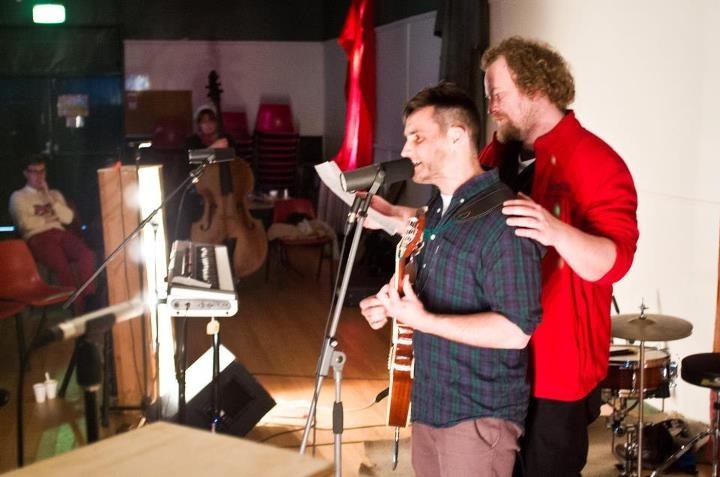
Seb and Jordan from Cracked Actor played as a duo, and my man Nick Peddle was drumming with his 8-piece Hug-Pop act Pocket Fox. I was doing my song-on-the-spot thing in the intervals.
Basically I get the crowd to yell out 15 words and then I have until the next interval to write a song that has all the words in it. Then I perform it straight away.
This time I had such evocative words as ‘appalling’, schizoid embolism’ and the ever-popular ‘penis’. Luckily Cammy T was there to hold up the lyrics for me and support me in his warm embrace.